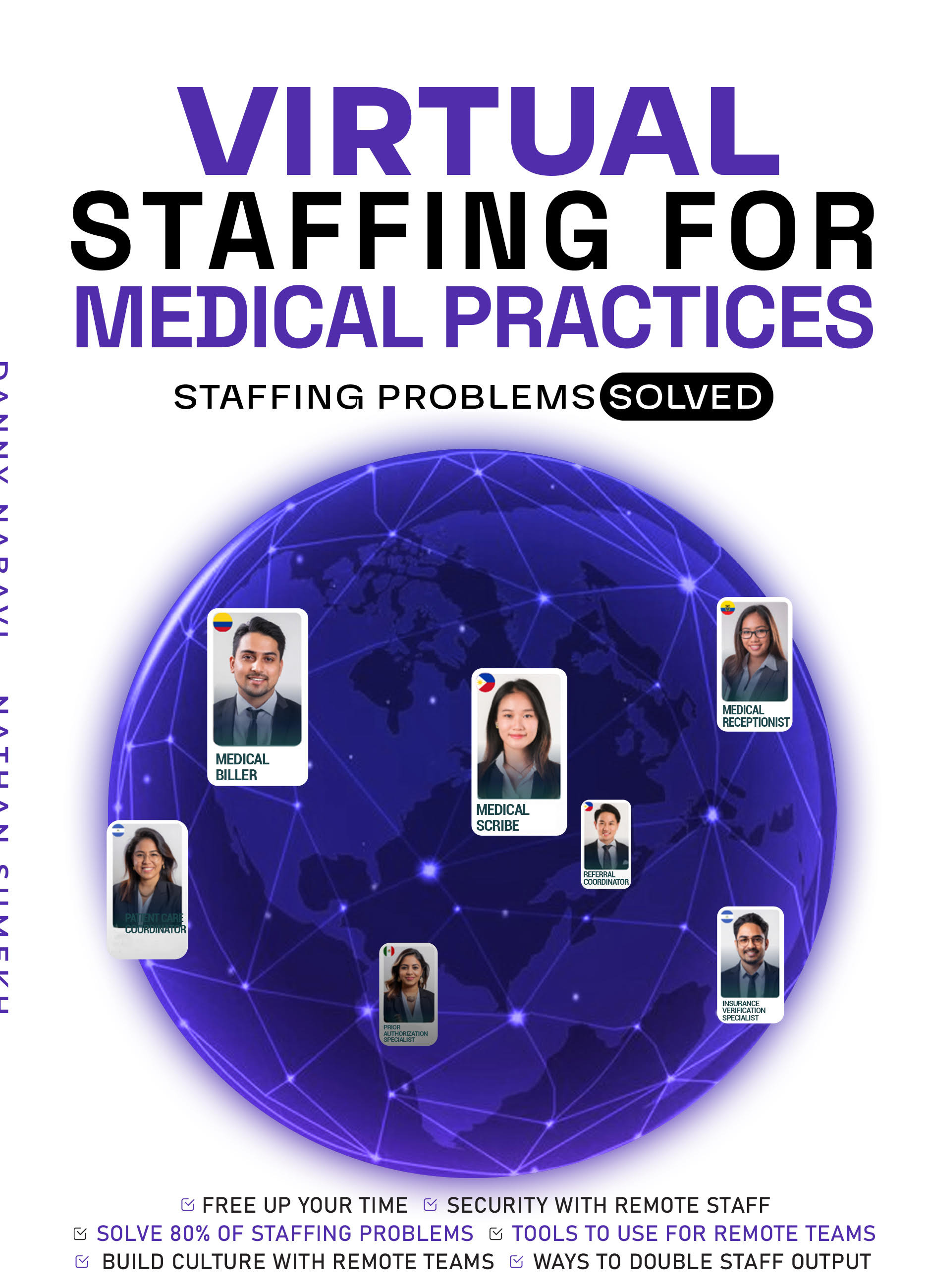
Virtual Staffing for Medical Practices
Staffing Problems Solved
A practical guide to building and managing remote teams inside medical practices.
By Danny Nabavi
Practice Owners and the People Who Actually Run the Schedule.
Physicians and practice owners hiring their first remote administrative staff; office managers inheriting a team they did not build; operators of multi-location groups trying to make the same process hold in every location.
The same questions came up in nearly every practice conversation, and the answers were operational, not strategic: how to write the role, how to run the first two weeks, what to measure, what to do when someone leaves.
Rather than repeat them, he wrote them down in the order a practice actually encounters them.
What a Remote Medical Team Actually Does
The functions that travel well, and the ones that don’t.
Writing the Role Before You Hire for It
Outputs, hours, escalation paths, and the two-page document that carries them.
The First Two Weeks
Onboarding a person into a practice they will never walk into.
Managing Work You Cannot See
Throughput over presence; the handful of numbers worth watching.
When Someone Leaves
The handoff that keeps the practice running through the gap.
Scaling Past the First Hire
Making one working process hold across a team and a second location.
If the role only exists in someone’s head, you have not hired a person. You have rented a dependency.
Presence is not a measure of remote work. Charts closed by Friday is a measure of remote work.
Every practice eventually loses the person. The only question decided in advance is whether it also loses the week.